Measurable Reach creates planning certainty – Impact makes the difference

With the planned convergent moving image measurement by Mediapulse, a standardized measurement for TV, Online Video (OLV), and Connected TV (CTV) will be established in Switzerland for the first time. Goldbach is actively involved as the first market partner in this development. A standardized measurement creates transparency, makes Reach comparable, and ensures greater planning certainty. In the long term, it aims to form the basis for a common currency in the Swiss moving image market.
However, Reach alone does not yet answer the most important question:
What impact does Advertising actually achieve?
Goldbach addresses precisely this question with Swiss Ad Impact. For this meta-analysis, data from 68 Swiss campaigns with TV and Online Video, as well as 13 campaigns with TV, Online Video, and Connected TV, which have been measured as part of Swiss Ad Impact since the beginning of 2024, were evaluated. The results show the role individual channels play in Reach and advertising impact – and why successful moving image planning requires both reliable Reach measurement and a sound understanding of advertising impact.
The most important findings at a glance
Online Video increases advertising recall
Linear TV generates high advertising recall. However, anyone who wants to reach young Target groups today cannot avoid digital Video channels. The meta-analysis confirms exactly this.
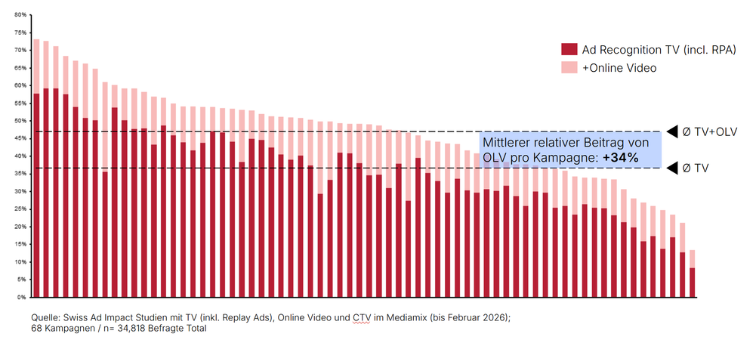
Across all campaigns studied, Online Video in combination with Linear TV increases advertising recall by an average of 34%. For 15- to 29-year-olds, this additional contribution is even stronger: here, advertising recall increases by an average of 48%.
Graphic 1: Incremental advertising recall for TV and OLV campaigns (Total):
Graphic 2: Incremental advertising recall for TV and OLV campaigns (15–29 years):
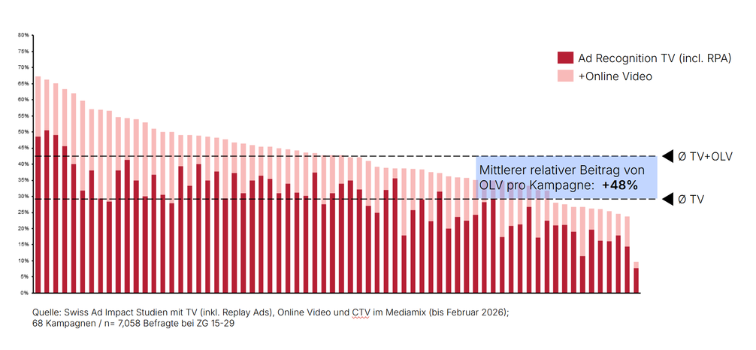
The results clearly show: Online Video increases the advertising recall of TV campaigns and helps to reach Target groups that are increasingly difficult to address through linear television alone.
➔ Online Video makes an important contribution to advertising recall within modern Total Video campaigns.
Visibility and impact are not the same
High visibility is important. But it is only one part of the success formula.
The analysis shows that individual channels have different strengths. While Online Video significantly increases a campaign’s visibility, other environments particularly demonstrate their strengths in impact-related key figures.
So-called lower-funnel KPIs such as information search, recommendation, and purchase intent were examined. The results show that TV contacts achieve particularly strong values for these key figures.
This suggests that factors such as attention, usage situation, and advertising environment have a significant influence on advertising impact.
Graphic 3: Advertising impact by channel (Ad Impact Overall):
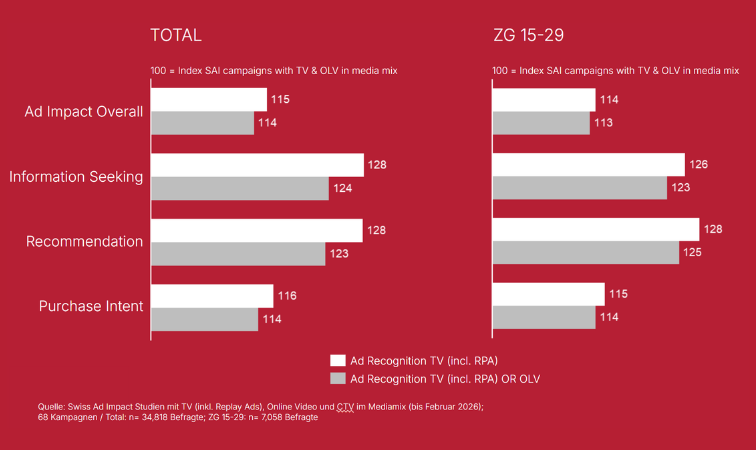
The insight from this is not that one channel is better than the other. Rather, the individual channels take on different tasks within a campaign.
➔ Visibility and impact are two different success factors – and both must be considered in campaign planning.
Connected TV: The best of both worlds?
The view on Connected TV is particularly exciting.
The additional contribution of Connected TV to campaign visibility is currently still relatively small. This is mainly due to the fact that the channel currently accounts for only a small share of the media mix in many campaigns.
At the same time, the Data shows above-average strong impact values – especially for information search and recommendation. This strongly suggests that Connected TV has high impact potential.
Graphic 4: Impact values of Connected TV
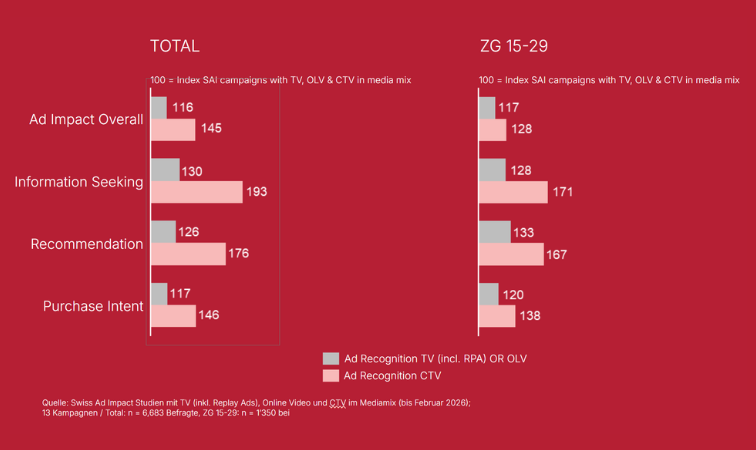
Connected TV combines the attention-grabbing television usage on the big screen with the possibilities of digital targeting. With increasing Reach and higher investments, its role within Total Video campaigns is likely to gain further importance.
➔ Connected TV already shows promising impact signals today and remains an exciting field of research for the future.
What does this mean for moving image planning?
The results make it clear that successful campaigns are not based on a single channel.
TV remains the most important driver of campaign visibility. By additionally using Online Video, visibility can be further increased – especially among younger Target groups. At the same time, TV shows its strengths not only in advertising recall but also when it comes to motivating people to act – for example, in information search, recommendation, and purchase intent. Connected TV has the potential to effectively combine the advantages of linear television and digital Video.
The future therefore lies not in TV, Online Video, or Connected TV alone – but in their interplay.
To the analysis
The meta-analysis is based on Goldbach’s Swiss Ad Impact Framework. 68 campaigns with TV and Online Video, as well as 13 campaigns with TV, Online Video, and Connected TV from a total of 16 industries, were analyzed. All campaigns have been measured as part of Swiss Ad Impact since the beginning of 2024.
The Data comes from population-representative surveys in German-speaking and Western Switzerland. Over 34,000 people were surveyed for the TV/OLV analysis, and over 6,600 people for the TV/OLV/CTV analysis.
The standardized methodology creates comparability across campaigns and environments and allows for the analysis of the specific contributions of individual channels independently of creative and campaign effects.
Swiss Ad Impact provides advertisers with standardized insights into the advertising impact of moving image campaigns, thereby creating a sound basis for Data-driven media planning.